

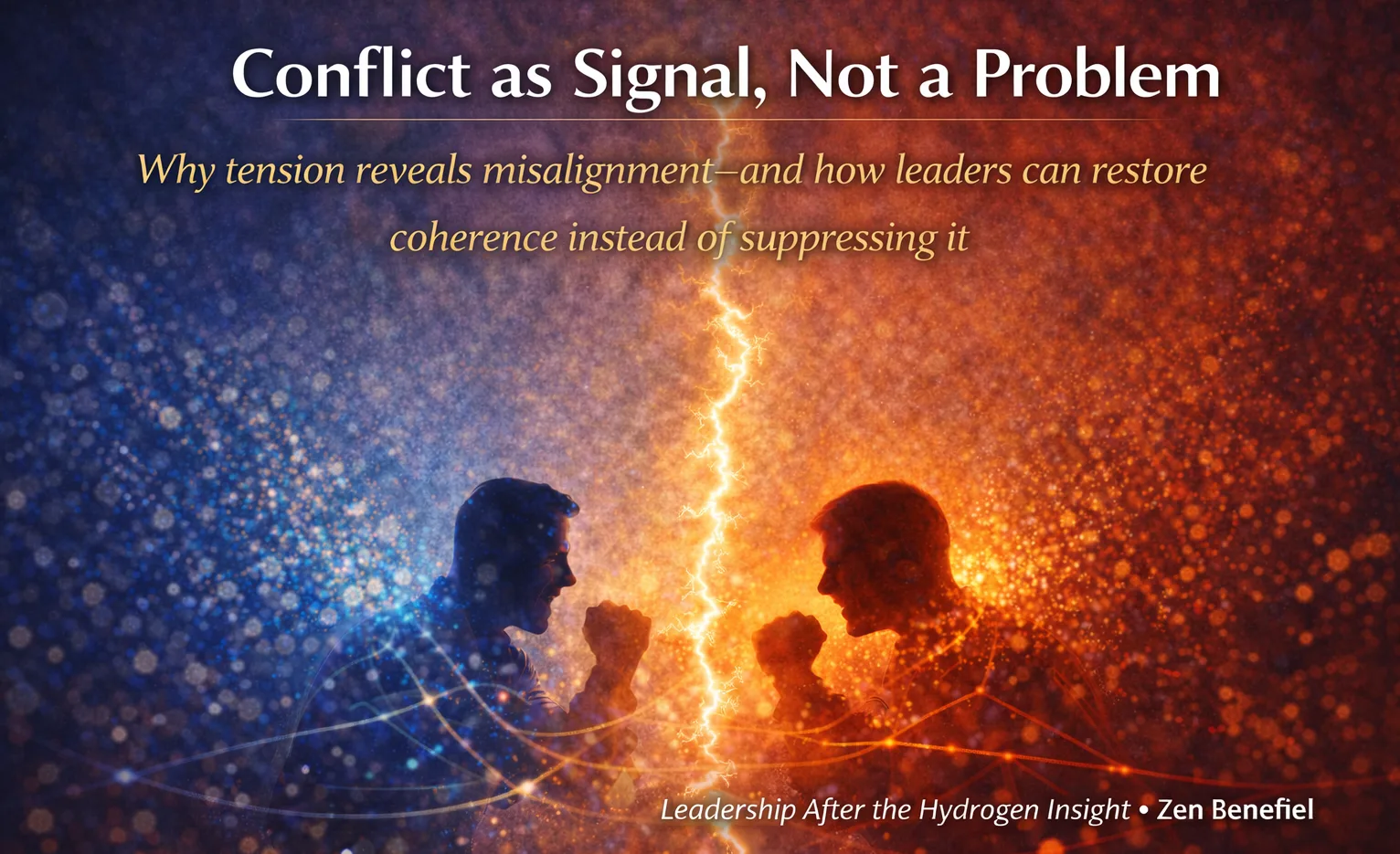
What if conflict isn’t something to eliminate—but a signal pointing directly to misalignment that needs attention?
Conflict is often treated as a breakdown in teamwork or a failure of leadership. Organizations work hard to minimize tension, smooth disagreements, and restore surface-level harmony as quickly as possible. Yet beneath that harmony, unresolved issues frequently continue to erode trust and performance.
This article reframes conflict as a diagnostic signal rather than a problem to be suppressed. Drawing on coherence principles, it explores how tension reveals misalignment within roles, expectations, incentives, or values—and how leaders can use conflict intelligently to restore alignment, strengthen trust, and improve collective outcomes.
Why tension reveals misalignment—and how leaders can restore coherence instead of suppressing it
Most organizations treat conflict as a failure. Something to be minimized, mediated, or moved off the agenda as quickly as possible. Leaders are trained to “resolve” conflict so work can continue.
But conflict is not the problem.
From a coherence perspective, conflict is information. It is a signal that alignment has broken down somewhere in the system—and that something essential is trying to surface.
The Hydrogen Insight, Translated
In physical systems, instability does not mean failure. It indicates misalignment of forces.
Hydrogen bonds destabilize when charge, distance, or orientation drift out of range. The instability is not the cause—it is the symptom. Stability returns only when alignment is restored.
Human conflict works the same way.
Tension arises when perspectives, roles, incentives, or values are no longer aligned within the field.
Why Suppressing Conflict Makes Things Worse
When leaders treat conflict as a behavioral issue, they often:
• Push for quick resolution without understanding the root cause
• Encourage politeness over honesty
• Frame disagreement as resistance or negativity
• Delegate conflict without addressing systemic causes
These responses may reduce visible tension—but they increase underground fragmentation. What is unexpressed becomes unresolved.
Conflict as a Diagnostic Tool
Conflict reveals where:
• Expectations were never aligned
• Decision authority is unclear
• Incentives are competing
• Values are interpreted differently
• Boundaries are poorly defined
Conflict is not a breakdown of teamwork. It is a map of misalignment.
The Leader’s Role in Conflict
Leaders do not need to fix conflict. They need to hold the field steady enough for truth to emerge.
This requires:
• Regulating emotional responses
• Slowing conversations
• Separating signal from story
• Naming misalignment without blame
When leaders remain coherent, conflict becomes generative.
When Conflict Is Working
Healthy conflict shows up as:
• Clear expression without accusation
• Disagreement that sharpens understanding
• Regulated emotion
• Resolution that produces clarity, not compliance
A Micro-Practice for Leaders
The next time conflict arises, ask:
“What is this tension trying to tell us about alignment?”
Then pause long enough to listen.
Reflection Question
Where might I be trying to eliminate conflict that is actually pointing toward necessary realignment?
CALL TO ACTION
If conflict feels chronic or disruptive, the solution is not avoidance.
It is coherence.
- Leaders: Treat conflict as system intelligence.
• Teams: Speak tension early.
• Organizations: Design structures that surface misalignment.
To explore conflict, coherence, and leadership in practice, let’s have a conversation.
Lead in presence,
Zen Benefiel