

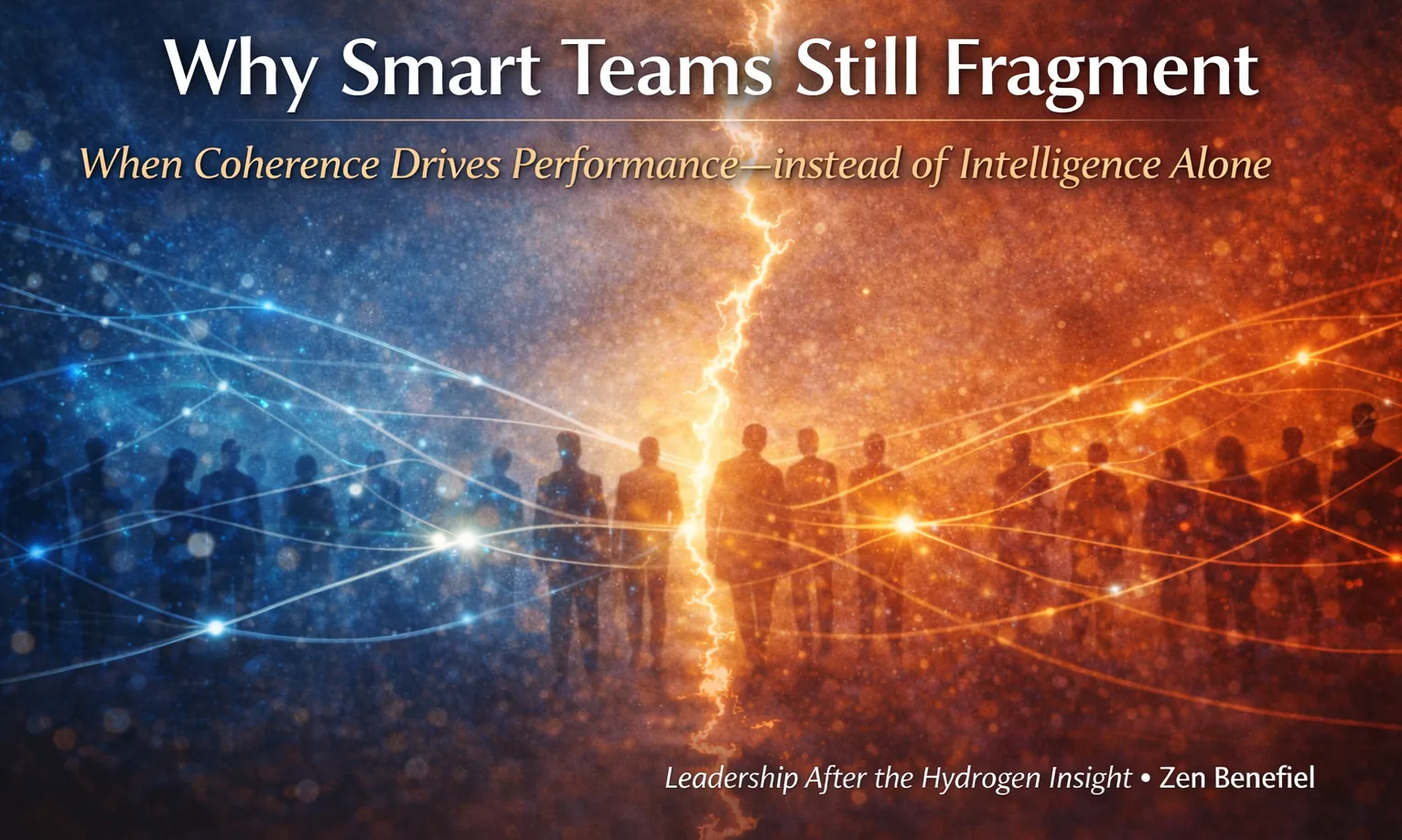
Why Smart Teams Still Fragment
Why do highly intelligent, well-intentioned teams still break down into silos, politics, and stalled momentum?
Many organizations assume that talent, intelligence, and shared goals are enough to ensure collaboration. When fragmentation occurs, the explanation is often framed in terms of personalities, incentives, or execution gaps. Yet some of the most fragmented teams are also the most capable.
This article explores why intelligence alone does not create integration. Drawing on coherence principles, it reframes team breakdowns as failures of alignment rather than competence—revealing how fragmentation arises when individuals optimize locally while coherence at the system level is left unattended.
Why fragmentation is a systems problem, not a talent problem
Organizations are often puzzled when their smartest teams struggle to collaborate. The people are capable. The goals are clear. The strategy is sound. And yet, work slows, friction increases, and silos quietly form.
This fragmentation is rarely the result of bad intentions or insufficient intelligence. It is the result of misalignment across the system.
From a coherence perspective, intelligence amplifies whatever conditions are present. When alignment exists, smart teams accelerate progress. When coherence is missing, intelligence accelerates fragmentation.
The Hydrogen Insight, Translated
In complex systems, structure depends on relational coherence, not individual capability. Hydrogen atoms may be stable on their own, but meaningful structures only form when bonds are aligned across the system.
Human teams operate the same way.
High intelligence at the individual level does not guarantee coherence at the collective level. Without shared orientation, local optimization replaces systemic integration.
Why Smart Teams Fragment
Fragmentation typically appears when:
• Goals compete instead of reinforce one another
• Incentives reward individual success over collective outcomes
• Information is unevenly distributed
• Decision authority is unclear or inconsistent
In these conditions, people make rational choices that inadvertently undermine the whole. Silos are not acts of defiance. They are adaptive responses to incoherent systems.
The Illusion of Alignment
Teams often appear aligned because they agree in principle. But agreement is not integration.
You can spot the illusion of alignment when:
• Meetings end with consensus but little follow-through
• Teams protect their scope instead of collaborating
• Issues reappear in different forms
• Responsibility is diffused rather than owned
What looks like resistance is often unresolved misalignment.
Integration as a Leadership Responsibility
Integration does not emerge spontaneously in complex systems. It must be stewarded.
Leaders support integration when they:
• Clarify how roles and teams interdepend
• Align incentives with shared outcomes
• Create forums for cross-boundary sense-making
• Address fragmentation early, before it hardens
When integration is present, collaboration feels easier—not because people try harder, but because friction is reduced.
Observable Signs Integration Is Restored
You know integration is improving when:
• Information flows across boundaries without prompting
• Decisions account for system-wide impact
• Teams seek input rather than defend territory
• Accountability feels collective
A Micro-Practice for Leaders
Ask your team:
“Where are we optimizing locally in ways that may be hurting the whole?”
Listen for patterns, not blame.
Reflection Question
Where might our current structures be unintentionally rewarding fragmentation over integration?
CALL TO ACTION
If smart teams are struggling, the solution is not more talent.
It is coherence.
- Leaders: Design for integration, not just performance.
• Teams: Notice where local success undermines collective outcomes.
• Organizations: Align structures, incentives, and authority with systemic coherence.
To explore integration and coherence in teams, let’s have a conversation.
Lead in presence,
Zen Benefiel