

Opening Question
What if trust isn’t something you ask for or earn—but something that emerges when people feel safe enough to align?
Trust is often described as a value, a belief, or a moral commitment. Leaders are encouraged to build it through transparency, consistency, and good intentions. Yet in many organizations, trust remains fragile even when these principles are sincerely applied.
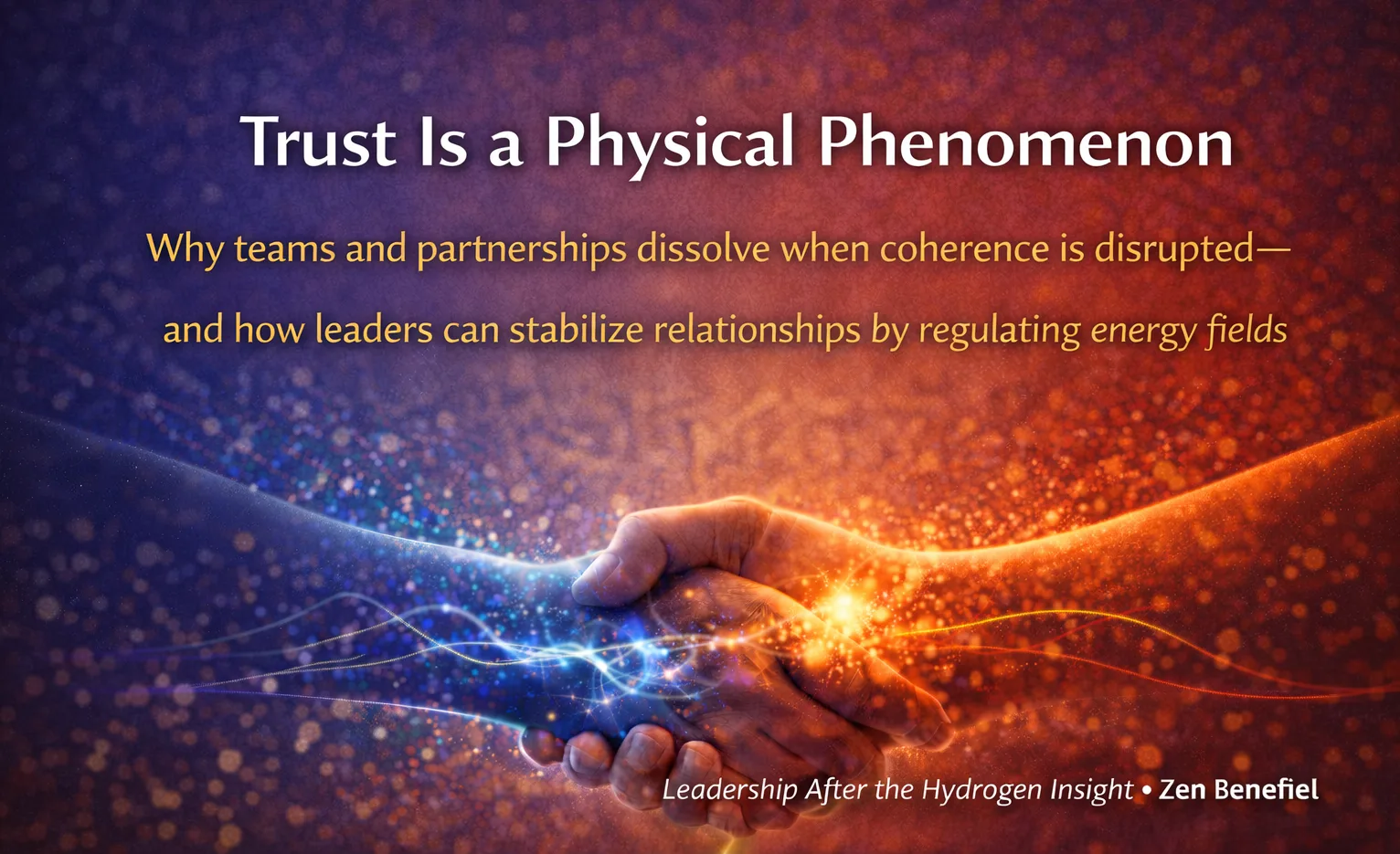
This article reframes trust as a physiological and relational phenomenon rather than an abstract ideal. Drawing on coherence principles, it explores how trust forms when nervous systems experience safety, predictability, and alignment—and why performance accelerates when trust is treated as a condition to be stewarded rather than a behavior to be demanded.
Why alignment, safety, and performance depend on more than belief
Trust is often spoken about as a value, an attitude, or a moral choice. Leaders are encouraged to “build trust” through transparency, consistency, and good intentions. When trust breaks down, the repair effort usually focuses on communication—clarifying messages, restating commitments, or offering reassurance.
Yet trust does not live primarily in language or belief.
It lives in the body.
From a coherence perspective, trust is not an abstract ideal. It is a physiological and relational state that emerges when conditions allow nervous systems to synchronize safely.
The Hydrogen Insight, Translated
Hydrogen bonds do not form because atoms want to connect. They form because conditions allow resonance.
Distance matters. Charge matters. Orientation matters. When these factors align, bonding occurs naturally. When they don’t, no amount of force creates stability.
Human trust follows the same principle.
People do not trust because they are persuaded. They trust when their systems sense safety, consistency, and coherence.
Why Trust Cannot Be Demanded
Trust collapses when leaders:
• Ask for openness without providing safety
• Encourage honesty while punishing dissent
• Promote collaboration while rewarding competition
• Speak reassurance while carrying visible tension
In these conditions, people may comply—but they do not synchronize. Their nervous systems remain guarded. Energy is spent monitoring risk instead of contributing insight.
Trust as Nervous-System Alignment
When trust is present, you can observe it physically:
• Shoulders drop
• Breathing slows
• Speech becomes more precise
• Listening deepens
• Disagreement remains regulated
When trust is absent:
• People hedge their words
• Meetings feel performative
• Decisions unravel after agreement
• Information is withheld or delayed
Trust is not what people say they feel. It is what their bodies allow them to do together.
The Leader’s Role in Trust Formation
Leaders do not create trust by asking for it. They create it by regulating the field.
Trust increases when leaders:
• Remain emotionally consistent under pressure
• Respond predictably to bad news
• Name uncertainty without panic
• Repair missteps without defensiveness
Why Trust Accelerates Performance
In a coherent, trusting system:
• Information flows faster
• Errors surface earlier
• Decisions require less enforcement
• Energy is spent creating, not protecting
Trust is not soft. It is efficient.
Micro-Practice for Leaders
Before responding to a difficult message or conversation, pause and ask:
“Will my response increase safety—or uncertainty?”
Then regulate before replying.
Reflection Question
Where might I be asking for trust while unintentionally creating conditions that make it unsafe?
CALL TO ACTION
If trust feels fragile in your organization, the solution is not more reassurance.
It is coherence.
- Leaders: Treat trust as a physiological outcome, not a slogan.
• Teams: Notice when safety allows alignment—and when it doesn’t.
• Organizations: Design conditions where trust can form naturally.
To explore trust, coherence, and leadership in practice, visit:
BeTheDream.com
Lead in presence,
Zen Benefiel