

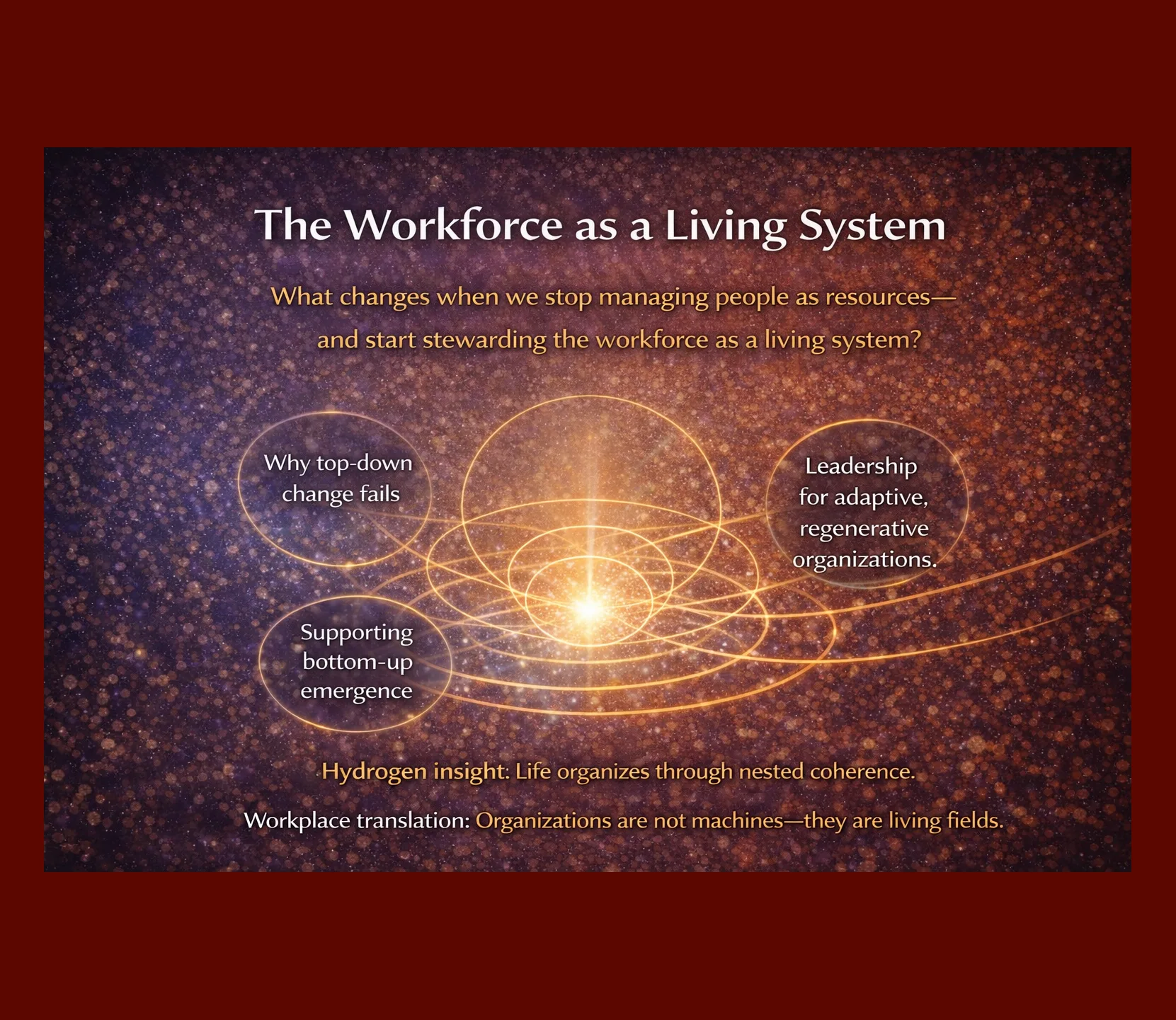
What if organizations stopped trying to engineer change—and instead learned to steward the conditions through which change naturally emerges?
Throughout this series, we have explored leadership and work through the lens of coherence—moving from invisible fields and trust, through alignment, conflict, decision-making, and performance. At each step, a consistent pattern appeared: when coherence is present, systems organize themselves; when it is absent, control and pressure fail.
This final article applies that insight directly to the workforce itself. Drawing on the hydrogen principle that life organizes through nested coherence, it reframes organizations not as machines to be managed, but as living systems whose intelligence, adaptability, and resilience emerge from the conditions leaders create.
Hydrogen Insight: Life organizes through nested coherence
In nature, order does not arise from centralized control. It emerges from layered coherence—systems within systems, each regulating itself while remaining responsive to the whole. Hydrogen illustrates this principle elegantly. Its bonding behavior enables water, organic chemistry, and ultimately life itself—not through command, but through relational alignment.
Stability comes from coherence across levels, not force imposed from above.
Workplace Translation: Organizations are not machines—they are living fields.
Most modern organizations are still managed as if they were mechanical systems: roles as parts, people as resources, performance as output. Change is introduced top-down, enforced through structures, policies, and incentives, with the expectation that compliance will produce results.
But living systems do not respond well to force.
Organizations behave more like ecosystems than engines. They adapt, self-organize, and respond to conditions. Culture, trust, innovation, and resilience do not scale through instruction—they emerge when coherence is present across the system.
When coherence breaks down, no amount of control restores vitality.
Practical Takeaways
Why Top-Down Change Fails
Top-down change assumes predictability and compliance. Living systems offer neither.
Change initiatives fail when they:
• Ignore local context and intelligence
• Override informal networks and relationships
• Demand behavior change without stabilizing conditions
• Move faster than trust can integrate
People may comply temporarily, but the system resists underneath. Old patterns reassert themselves because the underlying coherence was never addressed.
In living systems, imposed change creates fragmentation, not transformation.
Supporting Bottom-Up Emergence
Healthy change emerges from the edges inward, not the center outward.
Bottom-up emergence is not chaos. It is how living systems learn.
Leaders support emergence when they:
• Create psychological and relational safety
• Encourage experimentation without punishment
• Allow local adaptation within shared purpose
• Listen for weak signals instead of suppressing them
When conditions are coherent, innovation appears organically. Solutions arise closer to the problem. Energy flows toward what works.
The role of leadership is not to dictate outcomes—but to create the conditions where the system can evolve intelligently.
Leadership for Adaptive, Regenerative Organizations
In living systems, leadership shifts from control to stewardship.
Adaptive leaders:
• Regulate their own state under pressure
• Hold clarity without rigidity
• Strengthen coherence across boundaries
• Protect feedback loops instead of silencing them
Regenerative organizations don’t just sustain performance—they restore energy. People feel engaged rather than depleted. Learning replaces blame. Adaptation becomes continuous rather than episodic.
This is not a softer form of leadership.
It is a more realistic one.
Closing Reflection
If organizations are living systems, the central leadership question changes.
Not:
“How do we get people to change?”
But:
“What conditions are preventing healthy change from emerging naturally?”
CALL TO ACTION
The future of work will not be built through tighter control or faster mandates.
It will emerge through coherence.
- Leaders: Design for conditions, not compliance.
• Teams: Trust local intelligence and shared purpose.
• Organizations: Shift from managing parts to stewarding living systems.
To continue exploring leadership through coherence, let’s have a conversation.
Lead in presence,
Zen Benefiel