

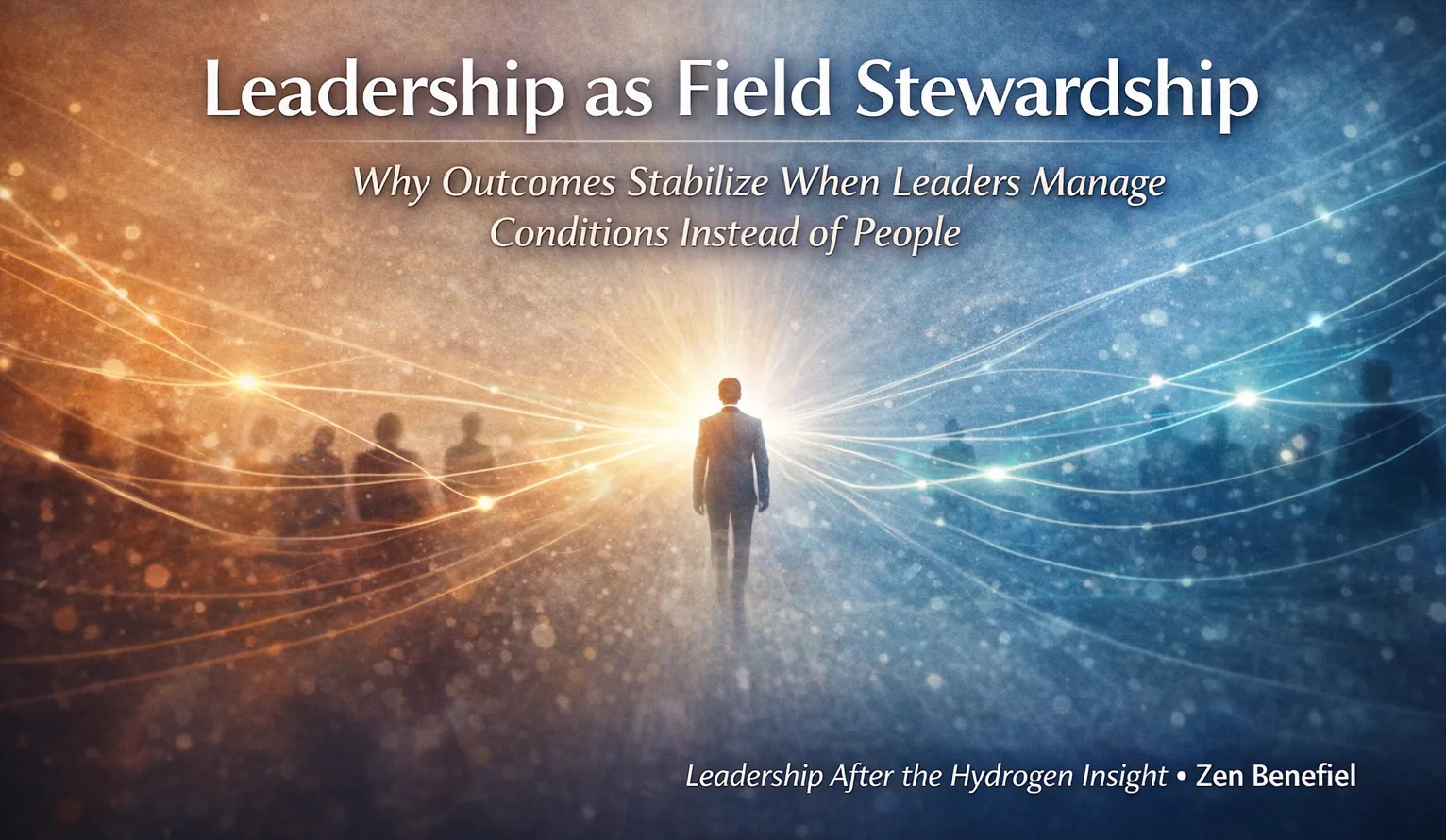
What if leadership isn’t about driving people—but about stabilizing the conditions they work within?
Leadership is often measured by decisiveness, authority, and visible action. Yet in complex organizations, those traits alone no longer produce stability or trust. In fact, they can unintentionally increase fragmentation.
This article introduces leadership as field stewardship—the practice of regulating emotional, relational, and attentional conditions so alignment can emerge naturally. Drawing on coherence principles, it reframes leadership effectiveness not as control over people, but as responsibility for the environments in which people think, decide, and act.
Why outcomes stabilize when leaders manage conditions instead of people
Most leadership models assume influence flows through direction, authority, or persuasion. Leaders are trained to set vision, drive execution, and correct behavior when results fall short. Yet in complex human systems, this approach increasingly fails.
From a coherence perspective, leadership is not primarily about directing action. It is about stewarding the conditions in which action emerges.
The Hydrogen Insight, Translated
Hydrogen does not manage particles individually. It stabilizes fields.
In physical systems, structure emerges when conditions—charge, proximity, and orientation—are held within coherent ranges. When those conditions destabilize, no amount of force restores order. Stability returns only when the field itself is regulated.
Organizations operate the same way.
People do not need to be controlled to perform. They need conditions that allow alignment, trust, and clarity to persist.
Why Traditional Leadership Creates Instability
Leaders unintentionally destabilize systems when they:
• React emotionally under pressure
• Change priorities without integration
• Speak values that contradict lived behavior
• Tolerate ambiguity while demanding precision
These actions disrupt the relational field. When the field becomes unstable, teams compensate through overwork, politics, or disengagement.
What Field Stewardship Actually Looks Like
Leaders steward coherence when they:
• Regulate their own emotional state before regulating others
• Hold clarity steady during uncertainty
• Name misalignment early, without blame
• Maintain consistency between words, decisions, and tone
Power Without Pressure
In a coherent system, leadership presence carries more influence than authority.
Observable signs include:
• Teams self-correct without escalation
• Difficult conversations occur without defensiveness
• Decisions hold without repeated enforcement
• Accountability feels shared rather than imposed
Why Self-Regulation Is Not Optional
A dysregulated leader cannot stabilize a system. Teams mirror the leader’s state, not their instructions.
Leadership effectiveness is constrained by the coherence a leader can sustain.
Micro-Practice for Leaders
Before addressing a team issue, ask:
“Am I trying to fix behavior—or stabilize conditions?”
Then regulate yourself before speaking.
Reflection Question
Where might my leadership be unintentionally destabilizing the field I’m responsible for?
CALL TO ACTION
If leadership feels exhausting, the solution is not more control.
It is stewardship.
- Leaders: Treat coherence as a core responsibility.
• Teams: Notice when conditions support alignment — and when they don’t.
• Organizations: Develop leaders who can regulate systems, not just manage outcomes.
To explore leadership as field stewardship in practice, let’s have a conversation.
Lead in presence,
Zen Benefiel