

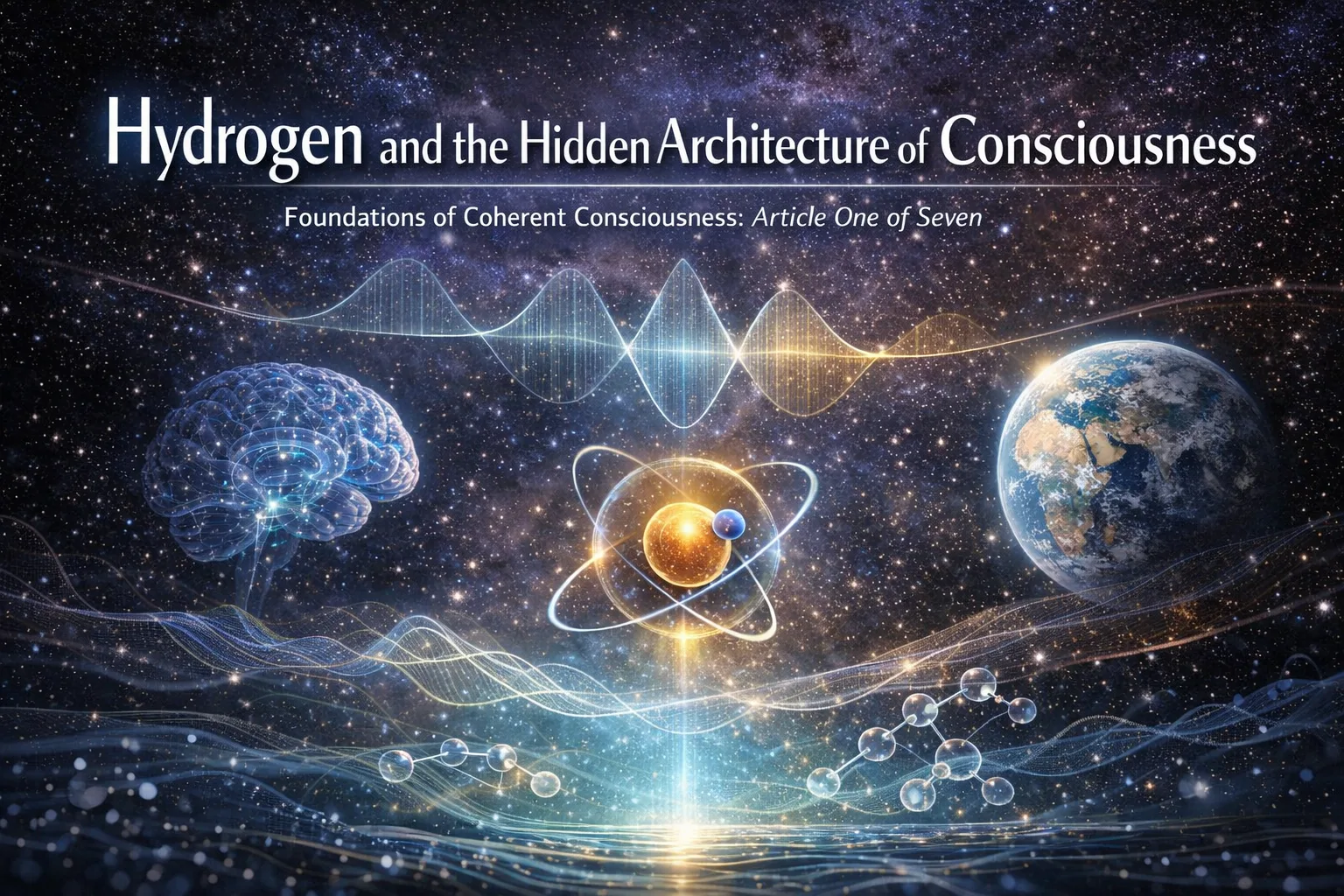
Article One of Eight: Foundations of Coherent Consciousness
Modern inquiry into consciousness has largely focused on structure: neurons, synapses, circuits, and computational models that attempt to explain awareness as an emergent property of complex biological machinery. This approach has yielded remarkable insights into how the brain processes information. Yet even with increasingly detailed maps of neural activity, the lived experience of consciousness—presence, meaning, coherence, and subjective awareness—remains unresolved.
This suggests a missing layer in the model.
In complex systems theory, structure alone is never sufficient to explain behavior. Every functioning system depends on a medium of coherence—a way for energy, information, and timing to remain aligned across components. In computing, code is inert without electricity, clock cycles, and synchronization. In ecosystems, organisms fail without relational balance. In cities, infrastructure collapses when flow is interrupted. The question, then, is not only what is built, but what allows it to stay in relationship.
Hydrogen may be central to that answer.
As the simplest and most abundant element in the universe, hydrogen occupies a unique position between energy and form. Composed of a single proton and electron, it is less a thing than a relationship—defined by probability, resonance, and interaction rather than solidity. Long before complexity arises, hydrogen establishes the conditions for connection.
In living systems, hydrogen is foundational yet often overlooked. It forms water, enables hydrogen bonding in DNA and proteins, drives proton gradients that power cellular metabolism, and subtly regulates neural activity through pH and charge dynamics. These hydrogen-based processes are not rigid or fixed. They are dynamic, reversible, and exquisitely sensitive to energy and environmental conditions.
From a systems perspective, this matters profoundly.
Hydrogen bonds are weak individually but powerful collectively, allowing biological structures to maintain form while remaining flexible and responsive. This creates architectures that support coherence rather than rigidity—systems capable of adaptation without collapse. Such properties are essential for life, but they are also strikingly consistent with the qualities associated with conscious awareness.
Research in quantum biology further reinforces hydrogen’s unusual role. Protons are light enough to exhibit quantum behaviors such as tunneling at biological temperatures, influencing enzyme function, photosynthesis, and genetic processes. Life already depends on quantum sensitivity, mediated largely through hydrogen. This positions hydrogen not merely as structural support, but as an active participant in energy–information exchange.
When viewed through this lens, consciousness begins to appear less like something generated by the brain and more like something transceived through it. The brain becomes a highly evolved interface—capable of tuning, modulating, and expressing coherent states—rather than a closed system producing awareness in isolation.
This does not negate neuroscience or carbon-based biology. Carbon provides stability, memory, and structure. But structure alone does not explain flow, presence, or meaning. Those arise when form remains coupled to field—when biological systems sustain coherence across scales.
Hydrogen, by virtue of its simplicity, ubiquity, and responsiveness, may function as a primary coherence medium in that coupling. Not as the source of consciousness, and not as its container, but as the enabling substrate that allows living systems to remain dynamically aligned with informational fields larger than themselves.
If this is so, consciousness is not something we own or manufacture. It is something we participate in—moment by moment—through the quality of coherence we maintain within ourselves, among one another, and with the living systems that sustain us.
This article establishes the elemental foundation for the series that follows. From here, we will contrast structure-based and coherence-based models of mind, explore biological and neural implications, and ultimately extend this understanding to collective, civic, and planetary scales.
Every complex system rests on its most fundamental relationships.
Hydrogen may be small—but in systems thinking, leverage often begins exactly there.