

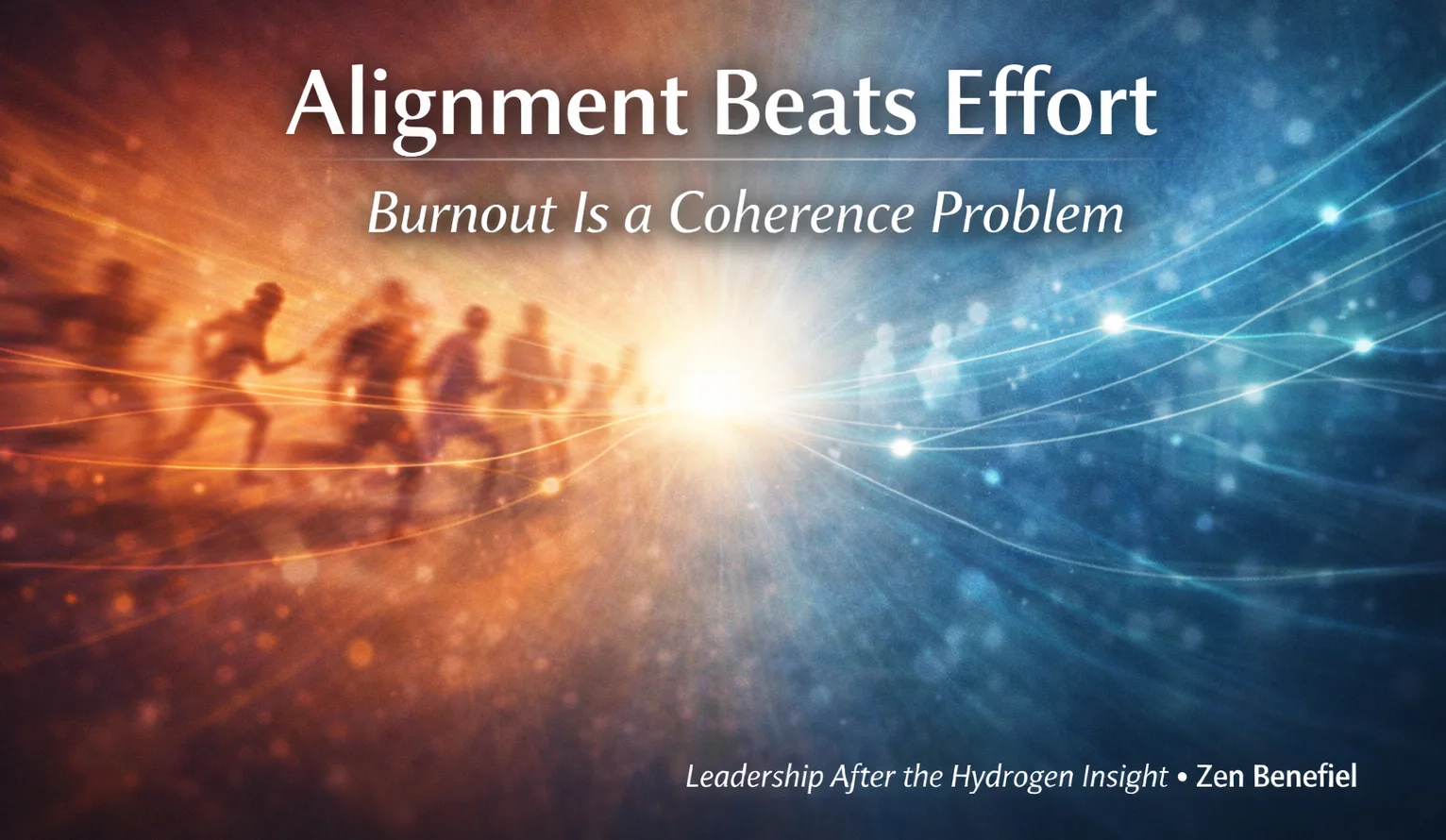
Why does working harder often lead to burnout—while alignment seems to restore energy almost immediately?
Burnout is commonly treated as an individual resilience problem. The remedies are familiar: better time management, wellness initiatives, encouragement to “take care of yourself.” Yet in high-performing organizations, burnout often appears even when people are capable, committed, and conscientious.
This article reframes burnout as a signal of misalignment rather than a failure of effort. Drawing on coherence principles, it explores why performance degrades when people are forced to compensate for unclear priorities, conflicting roles, or incoherent leadership conditions—and why restoring alignment reduces friction, effort, and exhaustion simultaneously.
This is the third article in a series translating coherence insights into practical leadership and workforce realities.
Why burnout, disengagement, and “capacity issues” are often misdiagnosed
Most organizations believe performance problems are solved by increasing effort. More hours. More urgency. More pressure. When results lag, leaders assume people are disengaged, under-skilled, or insufficiently motivated.
But effort is rarely the root issue.
From a coherence perspective, performance failures almost always trace back to misalignment rather than lack of capacity. People burn out not because they are unwilling to work, but because they are working against distorted conditions.
Effort compensates for misalignment—until it can’t.
The Hydrogen Insight, Translated
In physical systems, energy moves efficiently only when alignment exists. When forces are misdirected or opposing, energy is wasted as heat, friction, or instability. Increasing input does not solve the problem; it accelerates breakdown.
Human systems follow the same rule.
Effort applied to incoherent conditions produces exhaustion, not results.
Why Burnout Is a Signal, Not a Weakness
Burnout is often framed as an individual resilience issue. The solution becomes wellness programs, time management workshops, or encouragement to “take better care of yourself.”
While personal practices matter, burnout is more accurately understood as a system-level signal.
It appears when:
• Roles conflict rather than complement
• Priorities compete instead of align
• Values are stated but not embodied
• People are asked to care without agency
In these conditions, effort becomes compensatory. People push harder to make things work that cannot stabilize as designed.
The Cost of Misalignment
Misalignment shows up quietly at first:
• Slow decision-making
• Subtle resistance
• Rework and redundancy
• Emotional fatigue
Over time, it escalates into:
• Cynicism
• Attrition
• Chronic conflict
• Loss of trust
None of this is solved by asking people to try harder.
Alignment as a Leadership Responsibility
Alignment is not something teams figure out on their own. It is established—or undermined—by leadership decisions, clarity, and consistency.
Leaders create alignment when they:
• Clarify what truly matters—and what doesn’t
• Ensure roles make sense together
• Model coherence between words and actions
• Remove competing incentives
When alignment is present, effort drops and performance rises.
Observable Signs Alignment Is Restored
You know alignment is improving when:
• People stop asking for constant clarification
• Decisions stick without repeated enforcement
• Energy returns to conversations
• Accountability feels shared rather than imposed
Effort hasn’t increased. Friction has decreased.
A Micro-Practice for Leaders (This Week)
Ask your team one simple question:
“Where are you spending the most energy just trying to make things work?”
Listen without defending the system.
That answer points directly to misalignment.
Reflection Question
Where am I currently rewarding effort that exists only because alignment is missing?
CALL TO ACTION
If your organization feels stretched despite everyone’s best efforts, the solution is not more pressure.
It is alignment.
- Leaders: Diagnose friction before demanding performance.
• Teams: Name where effort is compensating for system gaps.
• Organizations: Design for coherence, not endurance.
To explore how alignment transforms performance and prevents burnout, let’s have a conversation.
Lead in presence,
Zen Benefiel